Friday, 25 May 2012

I Did Nazi That Coming

Iron Sky
Dir: Timo Vuorensola
Stars: Julia Dietze, Udo Kier, Christopher Kirby


After years of internet buzz surrounding its delayed Finnish-Australian-German production, I managed to finally see Iron Sky as it hit UK cinemas for one night only before its DVD release. I believe that I can safely say it is the best film about Nazis from the moon that I have ever seen.

Iron Sky begins with an American astronaut discovering a giant underground moon base, where the Nazis have been hiding out for seventy years. After his capture and interrogation, the moon Nazis must travel to earth in order to steal a mobile phone to power their outdated war machines, and pursue their maniacal plans for world domination. However, they must also confront the modernity and multiculturalism of 21st century New York, as well as the fury of the President of the United States (who happens to be Sarah Palin).

One would be forgiven for reading the plot summary of Iron Sky and expecting little more than a crass straight-to-video B-Movie. But what they may not expect is a well-written, well-produced and genuinely funny film that manages to go much further than one may expect from its premise. A far cry from the Nazisploitation movies of the 1970s such as Ilsa: She Wolf Of The SS, Iron Sky ditches the gore and torture in favour of satire – targeting both the Nazis and the UN as subjects of mockery. The film also gives hilarious nods to the likes of The Great Dictator, Dr. Strangelove and the Der Untergang internet meme, in order to connect the audience with the humour that has been found in the darker parts of history. Moreover, the film is impeccably scored and designed to give it an eerie underbudget feel reminiscent of Plan 9 From Outer Space, which is incredibly effective considering Iron Sky’s relatively modest €7.5m budget.

Although Iron Sky may not be breaking box-office records, or winning many prizes – I believe that it has the laughs, the kitsch and the timelessness to sustain a bright future as a cult favourite.

8/10

Friday, 11 May 2012

The Rise Of Joss Whedon

After a career writing for television spanning over 20 years, Joss "The Boss" Whedon has been propelled into the Hollywood limelight following the release of two films within a fortnight. The Cabin In The Woods and [The] Avengers [Assemble] are quite different films – one destined for cult status, and another a mega-budget blockbuster – yet they both exude the hallmarks of a writer with a great passion for his source material. It’s no secret that Whedon is a fanboy, and much of his television work (Buffy/Angel/Firefly) courted loyal cult followings. His big-screen directorial debut, Serenity, also displayed his ability to adapt longitudinal mythologies into fun, action-packed features. This skill of reinvention is the joy behind Cabin and Avengers, two films from overdone genres that, with a touch of Whedon magic, are original, fresh and funny.


The Cabin In The Woods

With Buffy, Whedon sought to subvert the idea of the little blonde girl in horror films who had always been the victim, and instead create a hero. In Cabin In The Woods, however, Whedon has gone a step further – creating a film in which the audience are the villain. I don’t want to give away too much of the plot to Cabin, as this comedy-horror’s strength lies in its originality and unpredictability. That said, the film is entirely constructed from overdone horror clichés, which don’t always run together smoothly. Yet there are still loads of laughs to be had from the shameful exploitation of gore, shock, sex and violence; as well as the ongoing meta-joke that the audience are pulling the strings of the action and baying for teenage blood. Whilst Cabin In The Woods isn’t perfect, it’s a hilarious and entertaining ride.
9 / 10


Avengers

Superhero movies have been flying out of the cinema at a rate of roughly one a month for the past two years. So you could be forgiven for expecting Avengers to be anything more than a group of superheroes you’ve seen before spitting out puns and fighting CGI monsters for 140mins. But surprisingly, Avengers has more to offer than that. It is clear that Whedon has a real interest in the characters and direction of the Avengers story; as the familiar heroes interact convincingly with unclichéd wit. Mark Ruffalo in particular delivers a standout performance as Bruce Banner – adding a real depth and vulnerability to a character that has been seemingly unplayable in recent years. Although there is a slight dip in momentum during the second act, the final action-packed battle sequence is hugely entertaining, and will have even the most snobbish film fan whooping like Michael Bay.
8 / 10

Wednesday, 14 March 2012

I Hate... Tim Burton


I believe that Tim Burton represents everything that’s wrong with 21st century cinema.

Since the release of Christopher Nolan’s Batman Begins in 2005, Tim Burton seems to have assumed that reinvention is remarkably simple. He takes a widely enjoyed film or play that has some kind of colourful or fantastic element, and then remakes it, billing his version as a “dark re-imagining”. However, unlike Nolan, Tim Burton isn’t interested in storytelling, breaking ground, developing technology or changing the way we think about cinema; his only goal is to squeeze as much money as possible out of pre-pubescent emo girls.

You see, what Burton actually means by “dark re-imagining” is manipulating the source material into a badly lit film in which Johnny Depp and Helena Bonham-Carter wear garish costumes and pasty make-up, and prance about acting Dickensian for 90 minutes in a world of saturated three-dimensional CGI. This method will of course always be successful because teenage emos hate staying in with their parents as much as they hate sunlight, and thus are guaranteed to spend money at the cinema.

The result is lazy, underwhelming and memory-destroying blockbusters such as Planet of the Apes, Charlie and the Chocolate Factory and Sweeney Todd assaulting our screens for years to come. Perhaps most sickening of all, the 3-D fad meant that Alice In Wonderland actually made more money at the box office than Empire Strikes Back and Return Of The Jedi combined, despite disappointing everyone who managed to stomach it.

Please Tim, stick to stop-motion, and leave my childhood alone.

Sunday, 26 February 2012

Minnie Stardust

Hunky Dory
Director: Marc Evans
Stars: Minnie Driver, Aneurin Barnard and Robert Pugh
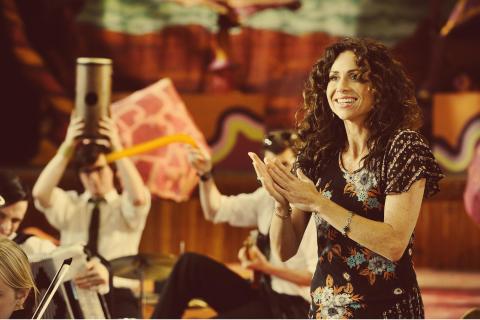
I usually despise musicals. I cringe at the sight of teenagers wearing pasted-on smiles, belting out show tunes whilst mid-conversation with stern authority figures. Yet Marc Evans’ Hunky Dory seeks to counter the contrivance of High School Musical and Glee, instead presenting us with a naturalistic drama that explores the lives of a dreamless bunch of kids in pre-Thatcher South Wales. Despite facing their last summer holiday before being destined for mediocrity, free-spirited drama teacher Vivienne May (Minnie Driver) wants her class to put on an end of year production of The Tempest “that William Shakespeare and David Bowie would be proud of” in order to give them some lasting hope of achievement.

The film follows the cast as they seek to produce a “Shakespearean concept rock opera”, despite disapproval from conservative teachers, prejudiced rugby coaches and skinhead relatives. The youngsters’ talents shine through, with the 1976 backdrop meaning ensemble performances of the likes of David Bowie, Nick Drake, ELO and The Beach Boys. There is a strong feel-good vibe to Hunky Dory, which dances between comedic musical and nostalgic drama with some success. Several character arcs map the cast’s progression through the stereotypical hurdles of adolescent strife – but all’s well by opening night, when the class perform relatively unscathed.

However, there is a great failing in Hunky Dory due to its poverty of originality. The setting and story borrow heavily from Richard Linklater’s Dazed and Confused and School of Rock, whilst the students’ individual stories aren’t given time to develop, and so seem to be pulled straight from Skins and Cemetery Junction. Perhaps Marc Evans bit off more than he could chew here. I imagine that Hunky Dory would play out quite well as a TV mini-series, and perhaps the predictable plot and two-dimensional characters may simply be a result of it being confined to 110 minutes. Nonetheless, the film is an easy watch, especially the final rendition of Life On Mars?, which is performed impeccably. Expect some warm chuckles in the hazy Welsh sunshine, but not riotous laughs. Hunky Dory won’t ever have you on the edge of your seat, but its pleasant enough to keep you in it.

6 / 10

Saturday, 25 February 2012

Original vs Remake: Willy Wonka/Charlie and the Chocolate Factory


Willy Wonka and the Chocolate Factory is a film very close to my heart. No matter how many times I watch Wonka, I still feel amazed, excited and heart-warmed by its elegance and ambition. Roald Dahl’s story of Charlie Bucket is of course familiar to everyone who didn’t spend their childhood sat in a corner eating crayons, and the charming children’s book is even more imaginative on the big screen. A superb cast of children and adults, led by the witty and whimsical Gene Wilder, adventure through impeccable set pieces in a musical masterpiece of family entertainment. A chocolate riverboat ride, singing Oompa Loompas, fizzy lifting drinks, and everlasting gobstoppers are but a few highlights in an exceptionally shot film that leaves children in awe and adults in stitches.

Then in 2005 came Charlie and the Chocolate Factory, a film that upon leaving made me want to go to court and point out on a doll of Gene Wilder exactly where Tim Burton ruined my childhood. All the subtlety and irony of the previous film was lost. The singing Willy Wonka with a twinkle in his eye became a cold and xenophobic Johnny Depp, whose every line was delivered like Michael Jackson giving a guided tour of Neverland. The Oompa Loompas and beautifully designed sets were replaced with a sickly smorgasbord of CGI. The characters ceased to be quirky and annoying eccentrics, and instead are just a detestable bunch of cretins. Perhaps worst of all, Christopher Lee is roped in to play Wonka’s dad in a needless back-story, probably because someone dared to tell Burton that he couldn’t have Saruman playing Grandpa Joe. Pretty much every aspect of the remake degraded the original. Charlie is a bad egg that needs to be dropped into the incinerator and forgotten about.

Saturday, 18 February 2012

Preview: Django Unchained


Scheduled for release at the end of 2012 is the latest film written and directed by Quentin Tarantino. Following on from stylized revenge thriller Kill Bill, and slow-burning, dialogue-rich Inglorious Basterds; Django Unchained promises to be Tarantino’s most ambitious and enthusiastic homage to exploitation cinema yet. The “Django” in the title alludes to eponymous hero of Sergio Corbucci’s 1966 spaghetti western, which was deemed so violent that it was banned by the BBFC until 1993. Corbucci’s Django was, however, a huge cult hit and spawned over thirty unofficial sequels and countless reboots and pastiches. It is perhaps unsurprising, therefore, that avid cinephile Tarantino has decided to give the story a big-budget revamp into the mainstream.

In Corbucci’s Django, the protagonist is a mysterious coffin-dragging vigilante, who marauds the Old West seeking revenge. Django Unchained, however, tells the story of a freed slave, Django (played by Jamie Foxx), who treks across the American deep south with a German bounty hunter, Dr. Schultz (Christoph Waltz), in order to emancipate his wife from the clutches of a sadistic plantation owner Calvin Candie (Leonardo DiCaprio). The supporting cast is also set to feature performances from the likes of Samuel L. Jackson, Jonah Hill, Kerry Washington, Zoe Bell, RZA, M.C. Gainey, and the original Django - Franco Nero.

So what can we expect from the latest Django? Will the big budget and all-star cast lead to a huge hit or a mega flop? Given Tarantino’s previous efforts, and considering his passion for grindhouse movies and aesthetic violence, Django Unchained promises to be an intense Southern drama filled with cool, pithy dialogue, striking set-pieces and graphic, stylised action. Whether you’re Tarantino’s biggest fan or harshest critic, one thing’s for sure - Django Unchained will certainly be a major talking point over Christmas dinner.

Monday, 12 December 2011

The Thief And The Cobbler: The Recobbled Cut

In 1964 the animator Richard Williams sought to create the greatest animated film ever made – The Thief and the Cobbler. His magnum opus was to be entirely hand-drawn, at twenty-four frames per second, and self-funded by the odd spots of television work that he could pick up along the way.

Yet, in 1990, after Williams had worked as animation director on the hugely successful Who Framed Roger Rabbit?, he managed to secure a deal with Warner Bros. to finance the independent film that had become his obsession and life’s work. However, the enormous standard of detail in every hand-drawn frame led to the constant missing of deadlines, and Warner Bros ultimately pulled out their $24m of funding leaving the film unfinished and out of Williams’ control.

The Thief was eventually acquired by Miramax, a subsidiary of Disney, who laid-off Williams’ team of animators and re-hired them to work on Aladdin. Miramax heavily edited the film; re-dubbing voice rôles by 60s icons such as Sean Connery with the likes of Matthew Broderick, and adding songs and voices to previously silent characters in order to make the film more marketable. The re-titled Arabian Knight was given a limited release in 1995, and intentionally driven into the ground so that Disney could plagiarise Williams’ plot and key characters in order to create Aladdin – thus introducing the first wholly CGI characters, and hammering the final nail into the coffin of the Golden Age of Animation.

However, after much effort from animation fans, Richard Williams’ masterpiece has now been restored using early sketches and workprints, to follow his original script as closely as possible. The Recobbled Cut is available to watch for free on YouTube, and the result is an absolute joy. Considering that the animation is now half a century old, you have to keep telling yourself that you are not watching contempory CGI. Perfectly three-dimensional cylindrical staircases, chase scenes through Escherian buildings, heart-warming and terrifying facial expressions, and impeccable detail right down to the wallpaper of impossible constructs; The Recobbled Cut is a remarkable celebration of the painstaking efforts of a perfectionist animator, and the skill and desire of his masterpiece.

Monday, 28 November 2011

5 Moustachioed Comedy Characters

To celebrate Movemeber, here are five classic tash-sporting comedy stock characters:
5. The Pig
As worn by: Sherman Klump (The Klumps), Mr Creosote (The Meaning Of Life), Ron Jeremy. A disgusting flatulent lump. May have a sweet side, but certainly the last person you’d want to meet on a blind date.

4. The Comedy-Action Hero 
As worn by: Machete, Black Dynamite, Big Daddy (Kick-Ass). A troubled badass hell-bent on revenge. Moustache is quite possibly the source of their power.

3. The Sexist
As worn by: Ron Burgundy (Anchorman), White Goodman (Dodgeball), Uncle Rico (Napoleon Dynamite). A misogynist whose unsuccessfully attempts at seduction result in rage and/or inadequacy issues.

2. The Wise Man
As worn by: The Stranger (The Big Lebowski), Derek Smalls (This Is Spinal Tap), Sir Bedevere (The Holy Grail). The most trustworthy and learned of the cast. Usually calm in the face of adversity, an readily provides sage knowledge and advice.

1. The Clown
As worn by: Charlie Chaplin (The Great Dictator), Groucho Marx (Monkey Business), Borat. Use the moustache as a prop for comic effect. Perceived as dimwitted to those above their class, though undermine the bourgeoisie through subversion and wit. 

Sunday, 27 November 2011

Have 3D films not become a little two-dimensional?

I am optimistic about Arthur Christmas. Not only because of its strong British cast, and favourable reviews, but also because it is one of a small minority of 3D films with an original screenplay. In fact, of the forty 3D films released in 2011, only five are feature films that aren’t sequels, remakes or adaptations. Even when you discount the thirty adapted screenplays and the five 3D stage shows, the remaining five original films include Drive Angry, Sanctum and Shark Night, which have all received rotten reviews from critics and audiences alike.

Why is it then that only two original films, Arthur Christmas and Rio, have impressed when released in 3D? Some will say that obviously 3D films cost more and make more than their 2D counterparts. Audiences have to pay more to see them, and studios aren’t going to risk huge losses by bankrolling new and radical films for 3D release. But why the lack of original screenplays? Have movie-going audiences become so asinine and docile that they can only handle characters and situations they’ve seen before? This year has seen more film sequels released than any other, with original concept films becoming an increasing rarity.

I dread a future where a screenwriter’s job is to simply adapt old material. I would implore you to only go and see 3D films with original screenplays, but I’m not so naïve as to think that Rio 2 isn’t already in pre-production. No, the only option for the original film lover is to spend your money watching fresh and original 2D releases - boycotting the 3D monster entirely. Don’t feed it your ticket stubs because it will not be sated until 90-year old Jack Sparrow is staggering about fighting the Jigsaw killer in Pirates Of The Caribbean 21: The Final Destination of Kung Fu Piranha’s Fast Cars Transformer 3D.


Friday, 18 November 2011

5 Horrorble Mothers

5. Lynn Sear – The Sixth Sense
Cole Sear is haunted by visions of the dead. He confides in his therapist who, spoiler alert, turns out to be a ghost. So throughout the entire film Cole’s mother never attempted to seek help for her clearly troubled son. Scarily inadequate parenting.

4. Margaret White – Carrie
Carrie is humiliated at school after overreacting to her first period. It’s no surprise considering her mother is a religious zealot who poisons her daughter into thinking she’s leaking liquid sin. Her manipulation ultimately transforms Carrie from an innocent girl into a raging telekinetic monster.

3. Mrs. Voorhes – Friday The 13th
Camp counsellors are stalked and murdered in this knife-wielding POV slasher. Twenty years prior to the franchise-destroying Jason X, the schizophrenic Mrs. Voorhes was the original Crystal Lake killer, seeking vengeance for her drowned son.

2. Vera Cosgrove - Braindead
When Lionel’s mother is bitten by a rat-monkey, all hell breaks loose. Extremities drop off, a vicar kicks arse for the lord, corpses procreate, gallons of blood is spilt and zombies are obliterated by a lawnmower. Yet nothing is more grotesque than Lionel’s giant undead mother beckoning him to return to her oversized womb. “Come to mummy, Lionel!”

1. Norman Bates’ “Mother” - Psycho
Psycho established the archetype of the horror mother, and the psychotic-slasher subgenre. The Oedipal Norman Bates’ attempts to subdue his mother’s bloodlust, coupled with a stabbing scene without a single shot of a knife penetrating flesh, results in a perfect Hitchcockian horror.


Top 5 Intimidating Film Monologues

5) Taken - Upon finding himself on the other end of the phone from his child’s kidnapper, Liam Neeson (you know, the guy who mentored Obi-Wan Kenobi and Batman) coolly explains at length that not only is he expertly trained for this exact situation but also “…I will find you, and I will kill you.”

4) Full Metal Jacket – Gunnery Sergeant Hartman welcomes his ‘maggots’ to their first day of marine corps training with an improvised, expletive-ridden brow-beating. It speaks volumes for this scene that the least profane quote I can offer is: “How tall are you, Private…? 5”9? I didn’t know they stacked shit that high!”

3) Taxi Driver – The hairs on the back of my neck stood up when watching Robert DeNiro’s career-defining portrayal of the sociopath Travis Bickle, as he stares into the mirror and delivers the line “You talkin’ to me?”

2) Dirty Harry – When Clint Eastwood’s Detective Harry Callaghan apprehends a serial killer within grabbing distance of their weapon, he slowly raises his .44 Magnum, “the most powerful handgun in the world”, and asks: “Do you feel lucky? Well, do you, punk?”

1) Pulp Fiction – “…And you will know my name is The Lord when I lay my vengeance upon thee.
Samuel L. Jackson’s wide-eyed recital of Ezekial 25:17 is not only the conclusion to one of my favourite scenes in cinema, but is also the last thing any criminal wants to hear. Unfortunately for them, it probably will be.