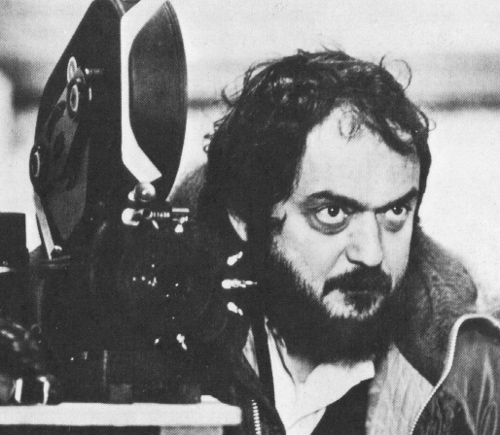
During a recent trip to Holland, I had the pleasure of attending the Stanley Kubrick Exhibition held at the EYE Film Institute in Amsterdam. The masterfully curated exhibit housed a wealth of material from the life’s work of arguably the most beguiling, ingenious and imaginative filmmaker in the history of cinema.
The exhibition began by showcasing some of Kubrick’s early photography work for Look magazine, including his first professional photograph – that of a newsvendor displaying a look of grief when selling papers reporting the death of Franklin D. Roosevelt. Several other magazine photographs of post-war America led to a small television screen showing Kubrick’s first documentary short Day Of The Fight, beside the camera with which it was shot.
Boxing was also the focus of his 1955 film Killer’s Kiss, which was projected on the first of the many large screens throughout the exhibit, alongside The Killing. An array of paperwork, from promotional material to budget calculation sheets, offered an insight into Kubrick’s early filmmaking efforts – and his rise to prominence.
The exhibition began by showcasing some of Kubrick’s early photography work for Look magazine, including his first professional photograph – that of a newsvendor displaying a look of grief when selling papers reporting the death of Franklin D. Roosevelt. Several other magazine photographs of post-war America led to a small television screen showing Kubrick’s first documentary short Day Of The Fight, beside the camera with which it was shot.
Boxing was also the focus of his 1955 film Killer’s Kiss, which was projected on the first of the many large screens throughout the exhibit, alongside The Killing. An array of paperwork, from promotional material to budget calculation sheets, offered an insight into Kubrick’s early filmmaking efforts – and his rise to prominence.
These were followed by individual projections of key scenes from each of the director’s more seminal pictures, which perfectly illustrated the scale of his illustrious career. Screenings of Paths Of Glory and Spartacus were flanked by original artwork and continuity sheets, exposing the detail with which grandiose war sequences were planned, alongside the original costumes worn by Kirk Douglas and Laurence Olivier.
Lolita and Dr. Strangleove…, began the unravelling of Kubrick’s strongest period as an auteur. Lolita was played alongside creative correspondence between Kubrick and the book’s author Vladamir Nabokov, as well as angry letters from religious groups denouncing the film. Highlights of the wealth of material surrounding Dr. Strangelove… included the original “Plan R” prop, the notepad on which Kubrick brainstormed potential titles (such as “Dr. Strangelove’s Secret Uses Of Uranus”), a scale model of The War Room, The Bomb itself, and two tickets to the cancelled premiere from the day President Kennedy was shot. There were also a set of stills from the abandoned “pie fight” ending sequence – which despite a five day shoot involving 3,000 custard pies, was dismissed by Kubrick as too farcical for satire.
2001: A Space Odyssey tends to speak for itself, though also featured one of the original ape costumes from the first monolith scene, a functional model of the rotating set used to film the zero-gravity centrifuge walk sequence, and the actual face of HAL-9000. A Clockwork Orange was my personal favourite exhibit. International artwork dedicated to the film surrounded the screen, which was buttressed by the original ivory devotchkas from the milkbar. Kubrick’s several drafts of the script stood alongside the letters of outraged cinemagoers and religious organisations (and a single hand-written letter from a fan demanding the picture feature less violence and more sex). The standout piece was the original droog costume, hat and cane infamously adoned by Malcolm McDowell.
Barry Lyndon was displayed alongside period costumes, and the groundbreaking camera with which it was shot, which allowed for the entire film to neglect artificial light in favour of natural and candle lighting. The Shining exhibit was exceptional; featuring Kubrick’s personal annotated version of Stephen King’s novel, the original costumes worn by the ghostly twin girls, a scale model of the labyrinth, the original axe and knife used during the bathroom sequence, Jack’s typewriter, and the actual photograph of the party at The Outlook Hotel in 1921, headed by Jack Torrance.
Full Metal Jacket played out behind the several books and scripts used to create the final draft, as well as photos of Kubrick and Matthew Modine on set. Private Joker’s original “Born To Kill” helmet was a particular highlight, presented opposite the director’s chair in which Kubrick himself sat. Eyes Wide Shut was projected on the final screen, hauntingly surrounded by all of the original masks and robes used in the central orgy sequence.
A final exhibit was dedicated to two of Kubrick’s unrealised works, Napolean and Aryan Papers. Despite lacking great visual substance, the wealth of information gathered for these two unfinished projects gave perhaps the greatest insight into Kubrick’s intelligence and perfectionism. He read over 500 books on Napolean’s life, and hired a team of historians to research the most minute details of historical events (such as the probable weather conditions during battles) in order to create what he promised movie studios would have been “the greatest film ever made”. A spectacle unsurprisingly cancelled after pre-production ran way over budget. Aryan Papers, involved a similarly obsessive research process into the hiding of Jews during the Holocaust, but was abandoned due to the emotional strain it took on Kubrick. He eventually concluded that an accurate film about the Holocaust was beyond the capacity of cinema, and abandoned the project around the release of Speilberg’s Schindler’s List.
The final piece displayed in the exhibition was Kubrick’s only personal Academy Award statue, received for special effects for 2001: A Space Odyssey. It is difficult to fathom how the man responsible for such breathtaking and iconic contributions to cinema, through incredible emotional and intellectual labour, could be so greatly undervalued by the Hollywood establishment. Yet the diversity and intensity of the body of work behind that single statuette served as an inspirational reminder that fame was never the reason that Stanley Kubrick wished to become involved in cinema. Instead, it was his unrelenting hunger to tell stories, his desire to raise questions, and his perfectionist approach towards every piece of work as having the potential to be the greatest possible contribution to cinema.

No comments:
Post a Comment